Sherlock Holmes - the Official website
About
 

The Sherlock Holmes company manages the primary Sherlock Holmes Brand. Within this website we hope to provide you with information on Sherlock Holmes. Please go to the Forum to enter your input to the community.

When Arthur Conan Doyle first introduced Sherlock Holmes to the reading public in 1887, nothing could have prepared him for the fact he had created a character who was destined to become the most famous detective in the world..


So famous that when Conan Doyle who had loftier literary ambitions feared that Holmes was keeping him from better things and tried to kill him in 1893, there was a public outcry. He held out for ten years, but finally resurrected Holmes in 1903 and continued writing Holmes stories until the end of his life. After Conan Doyles death in 1930, Sherlock Holmes enjoyed and continues to enjoy, what must surly be the most extensive afterlife of any character in fiction.

Reviewing Leslie S. Klingers The new Annotated Sherlock Holmes in The Times (12 December 2004), Professor John Carey asked: What do Sherlock Holmes and Father Christmas have in common? Answer: They make people want to believe they are real. According to Kingler (one of the world's foremost authorities on Holmes), there are 450 active Sherlockian societies around the world (America and Japan have the most) who are convinced that Holmes and Watson were real  at least for the purposes of their games and studies. Sherlockian (as they call them selves) meet regularly to discuss the great detective and add to the mountain of books and features about him.


For the rest of us, Sherlock Holmes has become part of British mythology. In British tourist publicity, Holmes is mentioned in the same breath as Robin Hood, King Arthur and Jack the Ripper. The character also enjoys global fame with all its attendant twenty-first-century spin-offs, and might be classified as one of more eccentric exports. As well as the societies and their websites, Holmes has inspired literally hundreds of books, films, plays and radio dramas, even video and board games. There are statues in London, Edinburgh, Crowborough, Sussex (where he lived), Meiringen, Switzerland (where there is a Sherlock Holmes museum) and even in Moscow. And Holmes London address at Mrs Hudson's house, 221B Baker street, has become one of the world famous literary addresses in the world. It now houses the Sherlock Holmes Museum the first Museum in the world to be dedicated to a fictional character.


During the 1951 Festival of Britain, a Sherlock Holmes exhibition was mounted at Abbey House in baker street, displaying a unique collection of original material as well as a reconstruction of Holmes sitting room and study at 221B Baker Street. After the exhibition closed, it toured the world, and then various items were transferred to the Sherlock Holmes public house on Northumberland Street in London and to the Conan Doyle Collection in Lucens, Switzerland, created in the early 1960s by Conan Doyle son, Adrian (now renamed the Sherlock Holmes Museum). Both feature the famous sitting room, though the Lucens has the added attraction of a Conan Doyle room, which contains a wealth of family heirlooms and souvenirs.
Holmes may have made Conan Doyle famous, but he was a diverse as well as prolific writer. His other works include historical and contemporary novels, science fiction (his Professor Challenger series) as well as plays and romances, poetry and a broad spectrum of non-fiction from military history to studies of spiritualism. But it is Sherlock Holmes who remains his most enduring creation.


Conan Doyle wrote four novels and fifty-six short stories featuring his super sleuth. All but four of them are narrated by Holmes great friend, assistant and biographer, Dr John H. Watson; two are narrated by Sherlock Holmes himself, and two others are written in the third person. Doyles first short novel about Holmes, A study in Scarlet, was first published in 1887 in Beetons Christmas Annual. He had written in six weeks in 1886 as a diversion from the more literary historical work to which he aspired, and Ward Lock paid him only £25 for all rights.


Holmes was an unlikely hero for late Victorian England, yet he embodied the triumph of order over chais, and for all his aloofness, there is always something profoundly reassuring about his presence. Originally inspired by Edgar Allan Poe French detective, C. Auguste Dupin, Conan Doyle set Holmes up in the cosy, cluttered interior of 221B Baker Street, London. The close friend and anonymous narrator of Poe stories became John H. Watson MD, a retired army doctor who shares Holmes apartment. Holmes intellectual prowess, his scientific attention to detail and skifil deductive powers, his scientific attention to detail and skilful deductive powers are offset by his eccentricities (cigars in the coal scuttle, tobacco in the toe of a Persian slipper) and his sense of alienation from the rest of humanity. He is a sufferer from spleen and ennui, who alleviates the deadly boredom of existence with injections of cocaine and morphine; an aesthete, a music lover and amateur violinist who, during the intervals in the action, will drag the philistine Watson to concert hall and opera house. (T.J. Binyon, Murder will Out, 1990)


 In 1890, Conan Doyle and Oscar Wilde were invited to dine with the managing editor of prestigious Philadelphia magazine Lippincotts. Joseph Marshall Stoddart was in London trying to set up a British version of his periodical, which specialized in printing full-length novels. At the Langham Hotel in Portland Place, Stoddart commissioned a sequel to A study in scarlet, which became the second Holmes mystery, The Sign of Four, and Wilde was commissioned to write what became his only novel, the Picture of Dorian Gray.


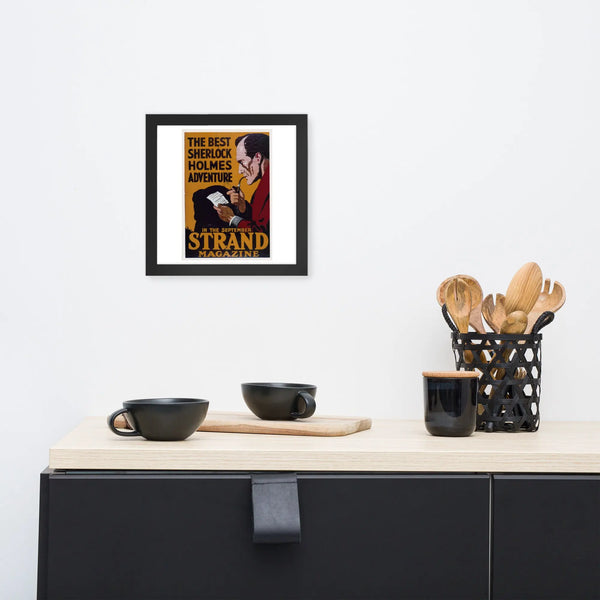
The period between 1890 and every one of then was clamouring for material. When the strand magazine was founded in 1891, Doyle prescently transferred Holmes and Watson to the compact short-story format and, beginning with A scandal in Bohemia, the magazine ran an entire series of stories which were collected into The adventures of Sherlock Holmes in 1892 in an edition of 10,000 copies, for which he was paid £1000, a vast improvement on Ward Locks earlier exploitative fee. The stories were an immediate success and made Conan Doyle world famous. In one of the great understatements of literary history, Doyle told his mother: Sherlock Holmes seems to have caught on.(Arthur Conan Doyle: A Life in letters, (eds.) D. Stashower, J.L Lellenberg and C. Foley, HarperPress, 2007)


 After A Study in Scarlet, Doyle had written Micah Clark (1888), a historical novel set during the Monmouth Rebellion, and a book he much preferred. This was followed by a short novel inspired by his early interest in theosophy  The Mystery of Cloomber  a very strange and confusing tale about the afterlife of three vengeful Buddhist monks. Its a story that perfectly illustrates the curious contradictions of Conan Doyles (he was born under the sign of Gemini) dual personality: his ability to write brilliantly about deduction and pure logic, and his lifelong fascination for the paranormal and spiritualism.


The Holmes stories placed Conan Doyle at the centre of a cult but, partly because he worried he would be forever typecast as the author of Holmes, and because he badly wanted recognition for his historical novels, he decided to kill off Holmes. Against his mothers advice, he devised Holmes death alongside  his old adversary, Professor Moriarty, in The Final Problem (published in  the Strand, 1893). Conan Doyle simply recorded in his diary Killed Holmes, not realizing that his creation was already indestructible.


After Holmes demise, his fans expressed their disappointment by writing angry letters and wearing black armbands, and the Strand lost 20,000 subscriptions. Conan Doyle had hoped he was free, but public demand was insistent and, in 1902, he published The Hound of the Baskervilles, supposedly an overlooked Holmes adventure from before his death. But then an offer (with considerable financial inventive) to revive his detective, arrived from Colliers Magazine in the United States.


It was too good to turn down. In the first story, The Adventure of the Empty House, Conan Doyle revealed that Holmes had not died at the Reichenbach Falls in Switzerland with Moriarty, and by 1905, a collection of thirteen new stories, The Return of Sherlock Holmes, appeared after serialization in the Strand Magazine and Colliers. The return was partly prompted by the success and return of the gentleman criminal,  Raffles, who had been created by Conan Doyle brother-in-law E.W.Willie Hornung.


There were plenty of Holmes imitators by this time, and perhaps Conan Doyle wasn't entirely comfortable with the though that his detectives throne was in danger of being usurped. For various reasons, he continued to write Holmes stories for another quarter of a century.


Arthur Ignatius Conan Doyle was born on 22 May 1859 in Edinburgh, the eldest son and third of nine children to parents of Irish descent, Charles Altamont Doyle, and Mary Foley, who had married in 1855. Both parents were Catholics and Arthur father was an artist, as were his paternal uncles (one of whom was Richard Doyle, who designed the famous cover of Punch magazine) and his paternal grandfather, John Doyle, the celebrated political cartoonist know as H.B. Not long after arriving in Edinburgh, Charles Altamont started to drink heavily. His alcoholism and subsequent epilepsy meant that he was eventually institutionalized. He died in an asylum in 1893  the same year that Conan Doyle decided to kill off Holmes.
Conan Doyle mother, whom he called the Mam, and to whom he was devoted, encouraged her son to explore the world of books. He was educated in Jesuit schools, which he didn't enjoy although he was a prize-winning student. He later used his friends and teachers from Stonyhurst College as models for some of his characters in the Holmes stories, among them two boys called Moriarty. By the time he left school in 1875, he had rejected Christianity and became an agnostic.


From 1876 to 1881 he studied medicine at Edinburgh University, including a period working in the town of Aston (now a district of Birmingham). While studying, he also began to write article and stories. His first published story appeared in Chambers Edinburgh Journal was Dr Joseph Bell, for whom he worked as an out-patient clerk. Bell was undoubtedly the inspiration for Holmes with his uncanny skill at observation and diagnosis. It was these closely observed skills that provided the basis for Conan Doyless Sherlock Holmes method. Conan Doyle was one of the best students I ever had, Bell has been quoted as saying. Exceedingly interested always in everything connected with diagnosis. Following his graduation, Conan Doyle served as a ship doctor on a voyage to the West African coast. To his other degrees, he added his MD, also from Edinburgh, in 1885 (on aspects of syphilis, using literary as well as medical evidence).


 After an ill-fated partnership in Plymouth general practice with George Budd, a former classmate, Conan Doyle moved to Southsea, Portsmouth where, after a slow start, he gradually built up a successful medical practice from 1882 to 1890. Always a keen sportsman, in Southsea he was able to play football for an amateur side, and was a keen golfer and cricketer. Between 1900 and 1907, he played ten first-class matches for the MCC.


 On a 6 August 1885, he married Louise Hawkins (known as Touie), the sister of one of his patients. It was the 1880s that provided a turning point for Doyle fiction when, in 1886, he created Sherlock Holmes. He wrote:

I felt now that I was capable of something fresher and crisper and more workmanlike. Gaboriau [Emile Gaboriau, the French journalist who created
Monsieur Lecoq, the policeman hero of his eponymous 1868 novel] had rather attracted me by the neat dovetailing of his plots, and Poe masterful
detective, M. Dupin [who first appeared in The Murders in the Rue Morgue (1841)] had from boyhood been one of my hereos . But could I bring an 
addition of my own ? I thought of my old teacher, Joe Bell, of his eagle face, of his curious ways, of his eerie trick of spotting details.

Writing to Dr Bell on 4 May 1892, Conan Doyle declared: It is most certainly to you that I owe Sherlock Holmes I do not think that analytic work is in the least an exaggeration of some effects which I have seen you produce in the out-patient ward.


Dr Bell, though flattered by the compliment Conan Doyle had paid him, had a different view of the origins of the great detective and told him: You are yourself Sherlock Holmes, and well you know it (Alan Bold, in Alan Bold and Robert Giddings, Who Was Really Who in Fiction, 1987) 
How Conan Doyle actually came to christen his detective is a matter of huge speculation. Early notes for A Study in Scarlet reveal that Watson was Ormons Sacker a name Gene Wilder used for Watson in his film Sherlock Holmes Smarter brother.


Holmes is almost certainly a homage to the American writer and doctor, Oliver Wendell Holmes, whom Conan Doyle revered, but Sherlock is slightly more ponderous. It may have come from Patrick Sherlock, a none-too-bright fellow pupil at Stonyhurst who, like Conan Doyle, was of Irish descent and to whom he was distantly related. But since Conan Doyle was a keen cricketer, Holmesian scholar prefer to pore over Wisden Cricketers Almanac for clues. One theory is that the same Sherlock was inspired by the Derbyshire and Nottinghamshire fast bowler Frank Shacklock and the wicketkeeper Mordecai Sherwin. Since Conan Doyle once faced Shacklocks bowling as a batsman, and the scorebook often read: caught Sherwin bowled Shacklock, it an alluring theory. It is often said that Sherlock Holmes older brother, Mycroft, was named after two brothers who also played for Derbyshire during the 1880s.


The Conan Doyles daughter, Mary, was born in 1889, and in the same year that The Adventures of Sherlock Holmes (1891) was published, A.C.D (as he often signed himself) and Louise spent two months in Vienna, where Conan Doyle studied with eye specialists before moving his family to London. He set himself up as an ophthalmologist, first in Bloomsbury and then in Wimpole Street. He was getting in the way. In 1892, he decided to quit medicine and devote his life, finally, to writing.


In November 1892, Louise gave birth to a second child, a boy they called Arthur Alleyne Kingsley. Accordingly, he moved his family to a house in South Norwood and when not writing was able to play cricket, tennis, golf and to cycle. But in the same year, Louise was diagnosed with tuberculosis, and Conan Doyle moved the family again to Hindhead in Surrey where the air was healthier for her.


After dispensing with Sherlock Holmes, Doyle devoted himself to the historical fiction by which he wanted to be remembered. The Brigadier Gerard stories, which looked at Napoleon Europe through the eyes of a besotted, somewhat absurd hussar in Napoleon army, replaced Holmes in the Strand Magazine. All but one of them were written between 1894 and 1903. The Gerard stories are distinguished achievements in intellectual as well as military and social history. They were later collected in The Exploits of Brigadier Gerard (1896) and The Adventures of Gerard (1903). Even without Holmes, Conan Doyle successfully invaded historical fiction using deductive methods and mistakes for Gerard and others.


In 1894 Conan Doyle embarked on a lecture tour of the United States and Canada with his younger brother, Innes, and took Louise on a recuperative journey down the Nile, which resulted in The Tragedy of Korosko (1898) about the adventures of a band of travellers during a Muslim uprising. In 1898-9 he produced Round the Fire Stories for the Strand Magazine, a mystery series worthy of recognition alongside the best of the Holmes cycle.


Conan Doyle success meant that he moved in all the important literary and political circles of his time. One of his dearest friends was J.M. barriers, and George Bernard Shaw (with Whom he locked horns on a couple of occasions) was a neighbour in South Norwood. He first met H.G Wells in Southsea when he worked in a drapers shop near Conan Doyles surgery. Jerome K. Jerome he knew as editor of the Idler for whom he wrote many of his medical tales before  they were collected in Round the Red Lamp (1894), a volume much admired by Rudyard Kipling, with whom Conan Doyle stayed in Vermont on his first American lecture tour. His dining companions included William Astor, Winston Churchill, Theodore Roosevelt and the Prince of Wales.


One of his greatest fans was P.G. Wodehouse (another regular contributor to the strand magazine before he moved to America after the Second World War), with whom he played the occasional game of cricket, and who is reported to have referred to Sherlock Holmes over 500 times during his writing career. He remained an admirer until the end of his life.


With the outbreak of the Boer war in South Africa in 1899, Conan Doyle (who was then forty) served as a doctor in the volunteer-staff Langman Hospital, after which he defended and justified British policy in The great Boer War (1900) and in The war in south Africa: Its Cause and Conduct (1902). The latter widely translated- became the major international advocate for the British case in the controversial war and, bowing to his mother insistence, Conan Doyle reluctantly accepted a knighthood for it in 1902. He also ran unsuccessfully for Parliament in 1902 and 1906 as a Liberal Unionist.


He remained a fervent advocate for justice. In the last years of peace before the outbreak of the First World War, His stories reflect a disintegrating world. He confronted his with his support for Roger Casement campaign against the Belgians continuation of Leopold slave state in the Congo; in his support for the legalization of divorce; and in his part in the exposure of grave miscarriages of British justice, namely that of George Edalji, a shy half-British, half-Indian lawyer convicted of a series of horse and cattle mutilations, even though these continued after his imprisonment. It was partially as a result of thus case that the Court of Criminal Appeal was established in 1907, so that not only did Conan Doyle help Edalji is told in fictional form in Julian Barnes 2005 novel, Arthur and George.


Louis Conan Doyle died in 1906, and on 18 September 1907, Doyle married Jean Leckie, whom he had known for over ten years. He first met Jean in March 1897 and fell deeply in love, though their relationship is believed to have remained on a platonic basis until their marriage. He celebrated the anniversary of their first meeting each year by presenting her with a single white snowdrop, but there was never any question of deserting Louise. He and Jean moved into a new home called Windlesham, near Crowbrough in Susses, where they lived until his death. They had three children: Denis (b.1909), Adrian (b.1910), and Jean Lena Annette (b.1912), later Air Commandant Dame Jean Conan Doyle, head of the Women Royal Air Force.


In 1912, Conan Doyle published The Lost World, a tale of pre-history alive and well on a remote South American plateau. It introduced his eccentric explorer, Professor Challenger, to an unsuspecting world. The model fro challenger, to an unsuspecting world. The model for Challenger was his old physiology professor at Edinburgh, William Rutherford, and his new hero was the total opposite of Sherlock Holmes. Although Doyle saw the book as a  boy adventure story, it was in fact in his first foray into science fiction (though the expression had not then been formulated). Another four novels about Professor Challenger adventures followed 9 The Poison Belt appeared in 1913), and the series stands out as a masterpiece of the genre, clearly influencing as generation of late twentieth-century writers and films-makers from Michael Crichton (Jurassic park) to Steven Spielberg.
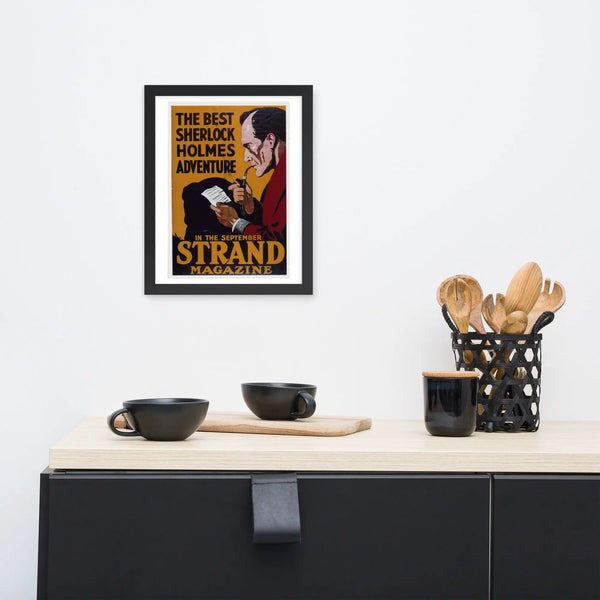

What Conan Doyle thought would be his last Sherlock Holmes story, The Valley of Fear, was serialized in the Strand magazine in 1914-1915. He was fifty-five when the First World War began, and although he tried to enlist, was Considered too old. He became a military correspondent instead, and in 1915 began writing his six-volume history of the British Campaign in France and Flanders. He was able to visit the British and French fronts, and completed the history in 1920. The war took its toll on Conan Doyle. He lost both his son, Kingsley (who had been wounded in the Battle of the Somme) in 1918, an his brother, Innes, to the Spanish flu pandemic, as well as two brothers-in-law and his two nephews.


He had always been fascinated by spiritualism and the occult, but with the deaths o those close to him, he became obsessed with the subject. Spiritualism believing that the dead communicate with the living  also provided a degree of peace of mind. During the 1920s, he embarked upon a worldwide crusade for spiritualism, taking his wife and children to America, Australia and Africa, where his ideas were not always well received. They dabbled in suances, made contact with their own spirit guide (Pheneas) and Jean even went so far as to develop the questionable talent of trance-writing.


He wrote very fiction during this tie, and in 1921, was so convinced about the veracity of the infamous Cottingley Fairies photographs, that he wrote a book about it (The Coming of the Fairies, 1922). It showed an endearing credulity for fairy phenomena which now appear to have been faked by sixteen-year-old Elsie Wright and her younger cousin, Frances Griffiths. The photographs show the two girls frocking with fairies in front of a waterfall at Cottingley in West Yorkshire. Conan Doyle gallantry and enthusiasm may have prevented their confession at the time, and it was some years before the truth about the images emerged. They had been cut out of Princess Mary gift Book, a wartime charitable initiative to which Conan Doyle had actually contributed a story.



In 1922, on a trip to New York, he became friends with the legendary American magician and escapologist Harry Houdini, who actually opposed the spiritualist movement in the 1920s after the death of his mother. Although Houdini insisted that spiritualist mediums employed trickery, Conan Doyle became convinced that Houdini had supernatural powers, which Houdini denied and set out to prove it. Their friendship remained antagonist right up to Houdini premature death from peritonitis in 1926.


In 1925, Conan Doyle had opened his own Psychic Bookshop and Museum in London ad the following year wrote The History of Spiritualism (1926). But by then, having spent a fortune in the pursuit of his esoteric dreams, he was faced with the need to earn some money. Professor Challenger and his colourful friends appeared again in another psychic adventure, the Land of mist, followed by The Disintegration Machine (1927) and When the World Screamed (1928).


He also wrote more Sherlock Holmes stories, though by now, Holmes was no longer the quirky, closet Bohemian, redolent of foggy, late-Victorian England, but a sadder figure ill at ease with the mores of a harder, modern age (Andrew Lycett, Conan Doyle)

In March 1927, shortly before the publication of his last Holmes story, The Adventure of Shoscombe Old Place, he wrote a piece in the Strand Magazine inviting readers to enter a competition (with a prize of £100) where they had to match their choice of the twelve best Holmes stories against the author personal selection. In June 1927 the Prize was won by mr r.T. Norman, of Wellingborough, Northamptonshire, who correctly named ten of Conan Doyle best stories. Seven competitors chose nine of the stories correctly and a great number were correct in naming eight stories. A hundred competitors were sent autographed copies of his memoirs, Memories and adventures(1924).


In the July issue of the magazine, Conan Doyle published an article, How I Made my List, that describe his process of selection. At first, he thought it would be the easiest thing in the world. From the start, he withdrew his last twelve stories. These had been scattered in various editions of Strand and would therefore not be readily available for readers selection. They were about to come out in volume form as The Casebook of Sherlock Holmes. If these stories had been available, he would have include two of them The Adventure of the Lion mane and The Adventure of the Illustrious Client in this list. But the first of these is recounted by Holmes himself. This was a method hampered the narrative, although he considered the actual plot to have been one of his best. The second story he also held in high regard, but its plot was by no means one of his best.


This lest him with about forty tales for his selection, several of which , he learned, were admired by his readers. He was certain that his grim snake story (the Adventure of the Speckled Band would be selected by many. He followed this with The Adventure of the Red-Headed League and The Adventure of the Dancing Men, because he considered them well-plotted. The Final Problem was the tale that deceived the reading public, as well as Dr Watson, into assuming that Holmes had been killed. He wanted his very first Holmes story A Scandal in Bohemia to be included, because it paved the way for all the others and had more female interest than usual. And Doyle considered that the story which undertakes to explain away the alleged death of Holmes and introduces the arch villain Colonel Sebastian Moran, also deserved its place among the twelve (Adventure of the Empty House).


Other seemed to select themselves, he said. the adventure of the Five Orange Pips, although rather short, had a very dramatic plot. He liked The Naval Treaty and The Adventure of the Second Stain, since they dealt with high diplomacy and intrigue, but there was not room for them both, so he selected The adventure of the Second Stain as the better of the two. These were followed by The Devil Foot, The Adventure of the Priory school, The Musgrave Ritual and The Adventure of the Reigate Squires.


Once The adventure of Shoscombe Old Place had appeared, all his recent stories could be collected in The Casebook of Sherlock Holmes, which John Murray published on 16 June 1927 in an edition of 15,150 copies, the largest since The Hound of the Baskervilles. (Andrew Lycett, Conan Doyle)


In 1929, on a trip to Holland, Denmark, Sweden and Norway, Conan Doyle was taken ill. His doctor diagnosed angina, and his health declined from then on. He died at the age of seventy-one on 7 july 1930 in his bed at Windlesham. His last words to his wife were: You are wonderful. He was buried in the rose garden at Windlesham, as was Jean when she died ten years later. Their remains were later moved to Minstead churchyard in the New Forest, Hampshire, when Windlesham became a home for the elderly.


It is ironic that while Conan Doyle most wanted to be remembered as a champion of spiritualism and as a historical novelist, it is Sherlock Holmes whose reputation has survived him. Indeed, Holmes is probably more famous now than he has ever been. The Holmes societies that exist all over the world, began as early as 1934, when the Sherlock Holmes Society was founded in London, at the same time as the renowned Baker Street Irregulars, in New York.


The stories have inspired numerous imitators, as well as countless stage and screen adaptations. The Guinness Book of World Records has consistently listed Holmes as the most portrayed movie character with over 70 actors playing the part in more than 200 films.


The first Holmes film was made in 1903 and a number of actors have become forever associated with the Great Detective. The American actor, William Gillette, played Holmes on stage from 1899 to 1932, but it is Basil Rathbone, who starred as Holmes alongside Nigel Bruce as Dr Watson in fourteen films between 1939 and 1946, who  with his trademark deerstalker hat, cape, pipe and magnifying glass probably did more than anyone to cement as a visual image of Holms in the public imagination. Other memorable portrayals were from John Barrymore, Clive brook (who played Holmes three times), Raymond Massey and Peter Cushing, who first appeared as Holmes in hammer Films The Hound of the Baskervilles (1958) and in a sixteen-part TV series in 1968/69, with Nigel Stock as Dr Watson. Cushing last appearance as Holmes was in the 1984 television film directed by Roy Ward Baker, Te Masks of Death, when Watson was played by John Mills.


In 1970, Billy Wilder directed Robert Stephens in The Private Life of Sherlock Holmes, alongside Colin Blakely as Watson. It was a quirky, heavily romanticized account that did little for the reputations of either Wilder or Stephens, and by creating a sexually potent but intellectually flawed Holmes, wilder virtually castrated the character (Michael Billington, Guardian, 29 November 2002). This has not prevented it becoming a cult film.


Jeremy Brett is generally considered to be the definitive Holmes of recent times, having played the role in four series (The Adventure of Sherlock Holmes) created by John Hawkesworth for Granada television between 1984 through to 1994 as well as depicting Holmes on stage. Brett Dr Watson was played by David Burke and Edward Hardwicke in the television series. The TV scripts were unusually very faithful to the original texts.


At the time of writing, Holmes is about to be re-interpreted all over again by the director Guy Ritchie, with Robert Downey Jnr as Holmes and Jude Law as Watson. Although the film is set in 1891, it is a film adaptation of producer Lionel Wigram (unpublished) Sherlock Holmes comic book. No sign of a deerstalker hat here. In early footage, Downey Jnr looks more like Charlie Chaplin, a role he played in an earlier in an earlier incarnation.


Perhaps one of the quirkiest twenty first-century homages to Holmes belongs to the award-winning American TV series House, which began transmitting in 2004, starring the British actor, Hugh Laurie. Now into his fifth season, Dr Gregory House is in many respects a medical Sherlock Holmes, and series creator, David Shore, has admitted that even Dr House name is meant as a subtle homage. The show draws heavily upon Holmes archetypes, such as House reliance on psychology to solve a case, his reluctance to accept cases he does not find interesting, his drug addiction (Vicodin instead of cocaine), his home address (apartment 221B), a complete disregard for social mores, personal talents (playing piano and guitar, rather like Holmes violin), as well as Holmes characteristic ability to judge a situation correctly with almost no effort. Dr House confidant and sounding board is Dr James Wilson.


In 1998, the BBC became the first production company ever to dramatize the entire canon of Sir Arthur Conan Doyle Sherlock Holmes stories and novels. Broadcast on BBC radio 4, this unique undertaking began in 1989 with Holmes and Watson first adventure, A Study in Scarlet, and ended with their most famous, The Hound of the Baskervilles. The stars were Clive Merrison and Michael Williams. The success of the programmes led to two follow-up series of new stories, The Further Adventures of Sherlock Holmes (broadcast in 2002 and 2004), starring Clive Merrison and Andrew Sachs.


Arthur Conan Doyle famous spirit guide, Pheneas, had a history of unreliable prediction, and perhaps that is as well. If Conan Doyle had had any preconception of the phenomenon he had unleashed, would he still have rescued Holmes from the watery grave of the Reichenbach Falls ? Holmes has morphed from a comfortable archive of stories and books into a full-blown industry, one which appears to be virtually limitless in its permutations. His appeal to all ages and nationalities never diminishes, and public appetite for the Holmes stories has continued for well over a century.


Perhaps the last word should go to P.G. Wodehouse, who moved to America permanently in 1947, and by 1955 had become a US citizen. But in his 1953 memoirs, Performing Flea, Wodehouse commented: Dont you find that as you age in the wood that the tragedy of life is that your early heroes lose their glamour ?... Now with Doyle I don't have this feeling. I still revere his work as much as ever. I used to think it swell, and I still think it swell.

 
Hoots


Get the Flash Player to see this player.

Update: Watch Episode II

>Watch Episode I
Subscribe

Please fill in your details below to subscribe to our newsletter
Name:
Email:

News
The Guinness World Records has consistently listed Sherlock Holmes as the "most portrayed movie character" with over 70 actors playing the part in over 200 films.

The latest Sherlock Holmes movie is based on the graphic novel by Lionel Wigram and directed by Guy Ritchie, the role of Holmes is performed by Robert Downey Jr., in a reinterpretation more focused in the character's martial abilities. A sequel is planned.

Check out the latest BBC show "Sherlock" - A 21st century version of Sherlock Holmes.

Sherlock stars Benedict Cumberbatch as the new Sherlock Holmes and Martin Freeman as his loyal friend, Doctor John Watson. Rupert Graves plays Inspector Lestrade.

The iconic details from Conan Doyle's original books remain – they live at the same address of 221b Baker Street, have the same names and, somewhere out there, Moriarty is waiting for them.

London Web Design by Digital